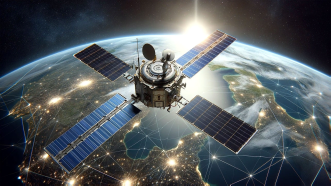
AI for Remote Sensing is a paradigm shift by leveraging AI to analyze vast geospatial data, unlocking unprecedented insights from satellite imagery. This synergy enhances environmental monitoring, disaster response, and sustainable resource management.
a. Improving Chlorophyll-a Estimation from sentinel-2 (MSI) in the Barents Sea
using Machine Learning
In this study, we aim to advance remote sensing methodologies for precise ocean
Chlorophyll-a (Chl-a) estimation in the Barents Sea. The approach integrates local
machine learning models with in-situ Chl-a observations and optical remote
sensing data. The proposed method includes incorporating pigment content
information by matching depth-integrated Chl-a concentrations with satellite data.
The developed neural network model, outperforms existing ML-based techniques
and regionally tuned empirical methods, showcasing substantial reductions in
mean absolute error.
Spatial window and depth-integrated match-up creation techniques further
enhance the OCN model's performance, emphasizing their efficacy in improving
Chl-a estimation precision through remote sensing.
Related Publications
b. Ocean Color Net (OCN) for the Barents Sea
We study the impact of rapid environmental changes in the Arctic, specifically the
Barents Sea, on ecosystem structure and primary productivity. The primary
objective is to refine the methodology for assessing these changes by estimating
chlorophyll-a (chl-a) concentrations through remote sensing of optical properties.
In-situ chl-a measurements spanning 2016 to 2018 capture spatial and temporal
variations across the Barents Sea.
Utilizing the Multi-Spectral Imager Instrument on Sentinel-2, the study proposes
a match-up dataset creation method based on remotely sensed reflectance spectra.
Evaluation of machine learning (ML) techniques, including the innovative Ocean
Color Net (OCN) regression model, reveals OCN's superior performance
compared to other ML-based techniques and empirical methods.
This research will emphasize the effectiveness of OCN in subarctic regions,
offering a more precise understanding of chlorophyll-a dynamics in the Barents
Sea. By leveraging remote sensing technology and advanced ML models, the
study contributes to a comprehensive assessment of the impact of environmental
changes on marine ecosystems in the Arctic.
Related Publications