
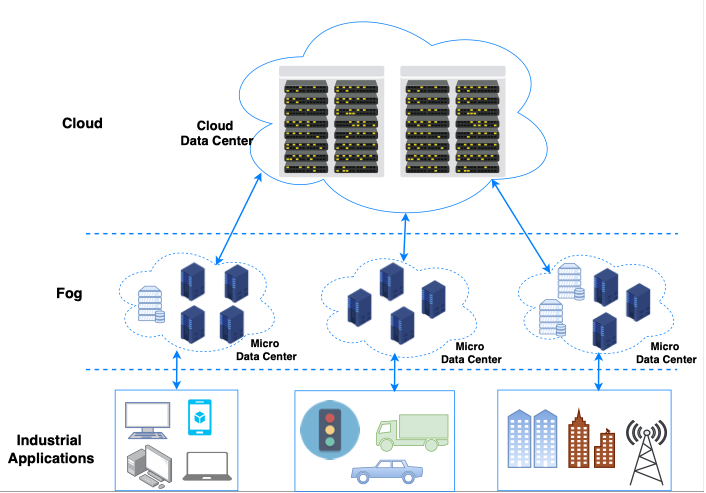
AI has transformed Cloud, Fog, and Cluster Computing, optimized resource allocation and paving the way for intelligent, responsive infrastructures at the forefront of computational innovation.
a. Predictive Auto Scaling of Microservices Hosted in Fog Microdata Center
This project introduces an innovative predictive auto-scaling method tailored for
microservices in fog computing, specifically within micro data centers (MDCs).
The approach employs a reactive rule-based auto-scaling method to gather a
training dataset, enabling the construction of an efficient predictive auto-scaling
model. Notably, the model is learned using an increasing synthetic workload,
showcasing its effectiveness.
The learned predictive auto-scaling model is then applied to manage application
resources efficiently across various realistic workloads. Experimental evaluations
conducted on real MDCs, encompassing both synthetic and realistic workloads,
demonstrate the superior performance of the proposed method compared to
existing rule-based auto-scaling methods. This highlights the method's potential
for optimizing fog computing environments by ensuring effective resource
management for microservices.
Related Publications
b Predictive Auto-scaling of Multi-tier Applications Hosted on Cloud Resources
This study addresses the challenge of performance variations in cloud resources,
specifically virtual machines (VMs), with the aim of efficiently auto-scaling
multi-tier applications despite these variations. The system utilizes supervised
learning to identify optimal resource provisioning for multi-tier applications based
on predicted response time and request arrival rate.
A key innovation is the creation of a configuration map by the learning method,
which remains invariant to VMs' performance variations. This allows for the use
of varying resources in predictive auto-scaling. Experimental evaluations
conducted with a real-world multi-tier web application on a public cloud
demonstrate improved performance with minimal resources when compared to
conventional predictive auto-scaling methods.
Related Publications
c Image Processing for High Resolution Video Streams using Hadoop and Spark Cluster Computing
This research focuses on addressing the challenge of efficiently processing large-
scale video streams generated by surveillance cameras. The proposed solution
explores the use of cloud services to handle high-resolution video streams,
employing Canny edge detection followed by Hough transform for line detection.
These algorithms serve as crucial preprocessing steps for subsequent tasks such as
object recognition, anomaly detection, and activity recognition.
The implementation and evaluation of the proposed approach in Hadoop and
Spark environments reveal that Spark exhibits excellent scalability. Moreover,
Spark outperforms Hadoop and standalone implementations for both Canny edge
detection and Hough transform. This suggests that Spark is a promising platform
for efficiently processing large-scale video streams, offering enhanced
performance compared to traditional Hadoop and standalone approaches.
Related Publications
d Web Application Resource Requirements Estimation based on the Workload Latent Features
This work introduces an innovative method for auto-scaling in cloud computing
platforms, with a specific focus on addressing challenges in scenarios
characterized by rapid workload increases and the risk of thrashing. The proposed
method leverages application access logs to accurately estimate hardware
resource demands and response time.
Key to the methodology is the application of unsupervised learning to compute
workload latent features from access logs. These features effectively estimate
response time, CPU, memory, and bandwidth utilization across various workload
patterns. The evaluation conducted with benchmark web applications
demonstrates the superior performance of the proposed method compared to
current state-of-the-art solutions. This showcases its potential for significantly
improving auto-scaling in dynamic cloud environments.
Related Publications
e. Dynamic Workload Patterns Prediction for Proactive Auto-scaling of Web Applications
This study develops a proactive auto-scaling framework for web applications,
aiming to address challenges associated with dynamic workload patterns. The
proposed method utilizes unsupervised learning on access logs to discover URI
space partitions based on response time and document size features.
These partitions serve as the foundation for computing Probabilistic Workload
Patterns (PWPs), which are probability vectors accurately representing the
distribution of incoming requests across URI partitions. The identified workload
patterns for specific time intervals are then utilized to predict the pattern for the
next interval. This predictive capability facilitates future resource demand
prediction and enables proactive auto-scaling in response to anticipate changes in
workload patterns.
Related Publications