Computational Imaging

Back to Verticals page

In the area of computational imaging, we aim to improve synthetic images by leveraging advanced algorithms and computational techniques. Our innovative approaches enhance generated images quality, enables new functionalities, and pushes the boundaries of what conventional image-generation can achieve.

a. Composite Image Synthesis

In this study, our focus is on refining image composition techniques, widely employed in the television and film industry for creating seamless synthetic visual effects. The goal is to develop methods that adeptly capture global effects linked with specific local content from one image and seamlessly integrate them into a second image.

Related Publications

b. Image Morphing

In this study, we focus on exploring image morphing techniques. We aim to facilitate the transformation from a source image to a target image by developing methods that seamlessly blend features, providing a comprehensive understanding of the morphing process.

Related Publications

c. Multi Focus Image Fusion

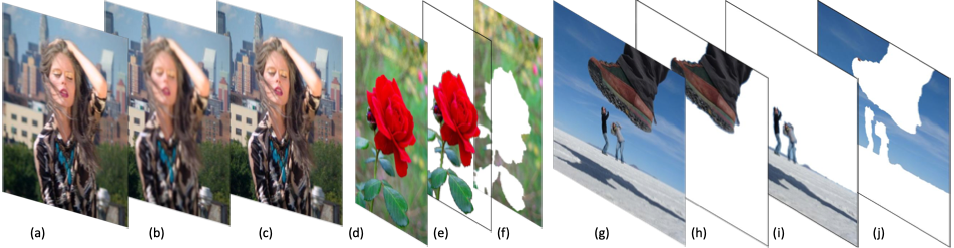
Multi-focus image fusion is a crucial research area within information fusion field. The primary goal is to extend the depth of field by extracting focused regions from multiple partially focused images and integrating them into a composite image where all objects achieve clarity. We develop multi-focus image fusion algorithms that employ Content Adaptive Blurring (CAB) and other techniques to detect and merge these focused regions.

Related Publications

d. Image Inpainting

In this study, our focus revolves around the imperative task of detecting and removing unwanted structures from digital images, particularly when essential parts of the scene become occluded by such elements. The challenge lies in the tedious and time-consuming nature of manually marking the boundaries of these unwanted structures. To address this, we introduce novel algorithms designed to efficiently detect and remove unwanted structures with minimal user input.

Related Publications