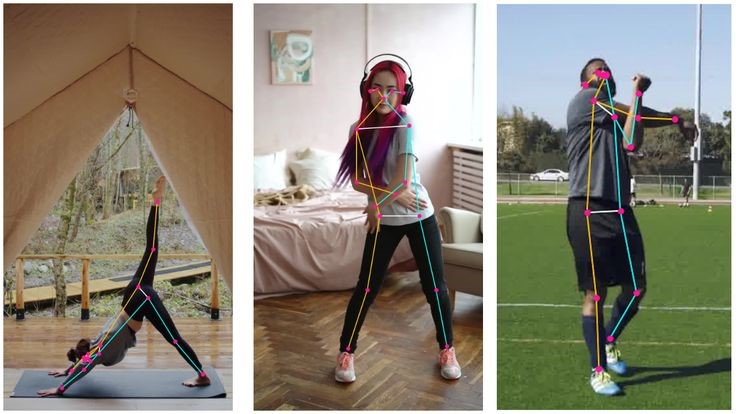

Vision for Human Pose Estimation

Back to Verticals page


In this vertical we advance computer vision techniques to precisely capture and interpret human poses, fostering applications in health monitoring, sports analysis, and human-machine interaction.

a. Quantification of Occlusion Handling Capability of a 3D Human Pose Estimation Framework

In the domain of 3D human pose estimation from monocular images, the challenge of handling occlusion remains less focused. This work introduces occlusion-guided 3D human pose estimation framework that use 2D skeletons with missing joints as input. Occlusion guidance is incorporated to provide additional information about a joint absence or presence, enhancing accuracy. We use temporal information to improve estimation when joints are missing.

Related Publications

b. A Boosting Framework for Human Posture Recognition

In many surveillance applications, automatic human posture recognition is crucial for monitoring various activities. To overcome challenges like occlusion, background clutter, and illumination variations, we combine spatiotemporal features such as aspect ratios, shape descriptors, geometric centroids, ellipse axes ratio, silhouette angles, and silhouette speed. We also leverage Radon Transform for enhanced shape-based analysis.

Related Publications

c. Walk Like Me: Video-to-Video Action Transfer

In this study, we explore different methods for transferring human actions from a source to a target video with improved human motion smoothness and better image quality. The project focuses on video-to-video action transfer GAN based algorithms that have achieved better image quality by employing a cascaded sequence of action transfer blocks with multi-resolution structure similarity (MR- SSIM) loss.

Related Publications

d. Human Fall Detection

Fall-induced damages are serious incidences for aged as well as young persons. A real-time automatic and accurate fall detection system can play a vital role in timely medication care which will ultimately help to decrease the damages and complications. We explore fast and more accurate real-time systems that can detect people falling in videos captured by surveillance cameras. Novel temporal and spatial variance-based features are proposed which comprise the discriminatory motion, geometric orientation, and location of a falling person.

Related Publications