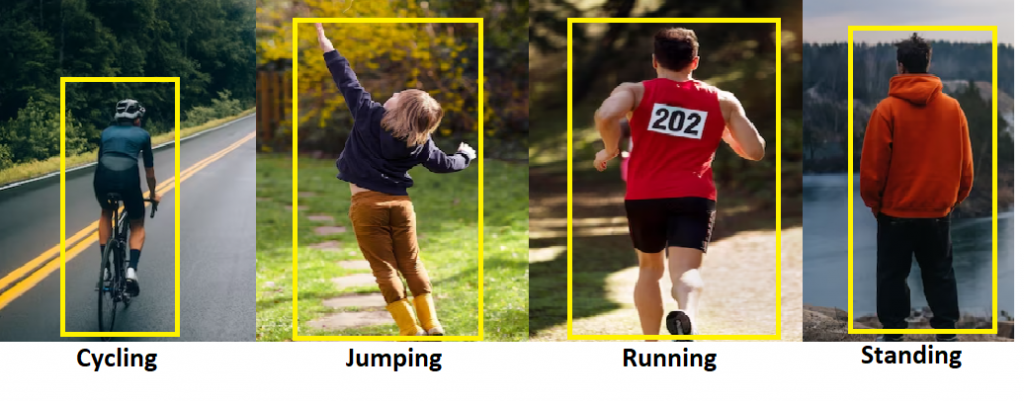
In this vertical for action recognition, we strive to develop cutting-edge technologies that
enable computers to interpret and understand human actions from visual cues. By
advancing algorithms and models, our goal is to enhance the accuracy and efficiency of
action recognition systems, paving the way for more effective security, surveillance and
human-computer interactions.
a. Cross-View Action Recognition
In this study, our primary focus is to develope techniques for 3D action
recognition that demonstrate robustness to variations in viewpoint. Our approach
involves the direct processing of point clouds, aiming to achieve cross-view
action recognition even in scenarios with unknown and unseen viewpoints. This
research seeks to enhance the reliability and versatility of 3D action recognition
systems, particularly in addressing challenges related to viewpoint variations.
b. Human Action Classification Using Locality-constrained Linear Coding
In this study, we focus on the development of locality-constrained linear coding
(LLC) based algorithms tailored to capture discriminative information from
human actions within spatio-temporal subsequences of videos. These algorithms
aim to enhance the efficiency of action recognition by effectively encoding
discriminative features within localized spatio-temporal contexts.
In this study, we concentrate on algorithms designed to merge discriminative
information derived from both depth images and 3D joint positions. The objective
is to achieve heightened accuracy in action recognition by leveraging the
combined strengths of these modalities. Through innovative approaches, we aim
to explore the synergies between depth information and 3D joint positions,
thereby contributing to the development of more robust and accurate action
recognition systems.